
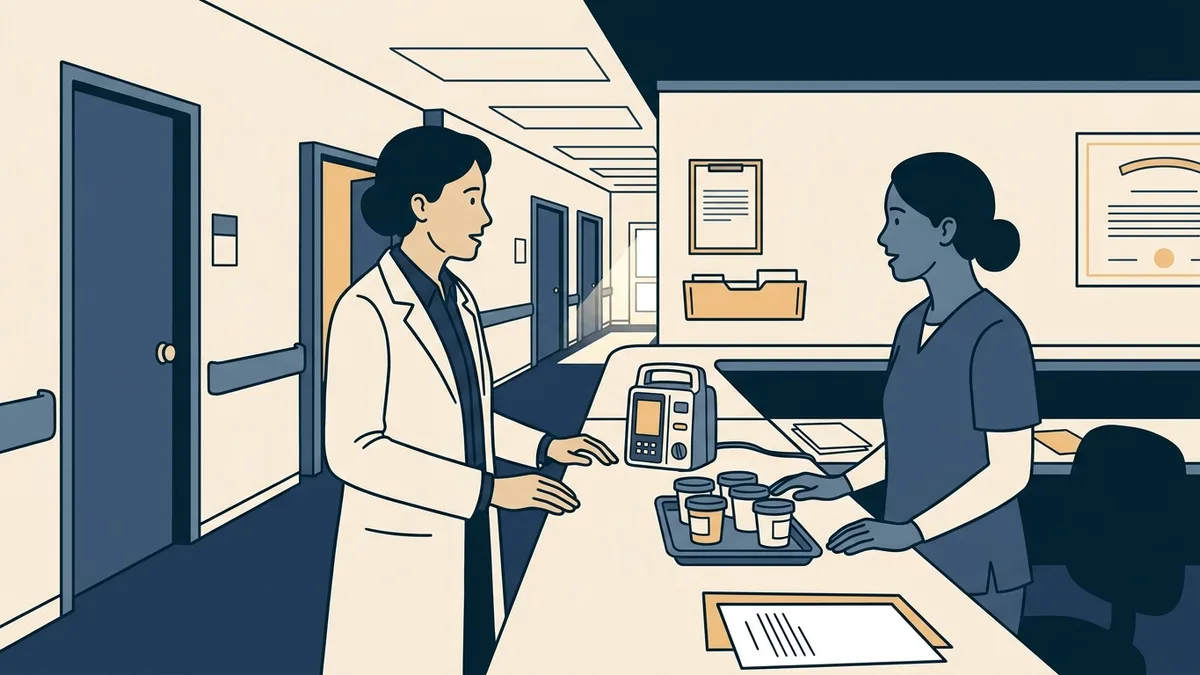
SAMHSA's 2024 rule (89 FR 7528), effective April 2, 2024 with compliance by October 2, 2024, removed the one-year opioid use disorder history for admission, let state-licensed practitioners such as NPs and PAs order MOUD where state law allows, widened take-home methadone, allowed telehealth intake, extended interim treatment to 180 days and clarified medication units.
On February 2, 2024, SAMHSA published "Medications for the Treatment of Opioid Use Disorder," the final rule that rewrote 42 CFR Part 8 (89 FR 7528). It took effect April 2, 2024, and programs had to comply by October 2, 2024. The rule's own summary says it made COVID-era flexibilities permanent and updated standards "to reflect an accreditation and treatment environment that has evolved since part 8 went into effect in 2001." A short correcting document followed on February 23, 2026, fixing outdated cross-references in 8.3(b) and 8.11 without changing any requirement (91 FR 8381).
For an opioid treatment program (OTP), the rule is less a single change than a new baseline. Policies written before 2024 will usually cite standards that no longer exist.
Who can now order medication at an OTP?
The definition of practitioner changed. Part 8 now defines a practitioner as "a health care professional who is appropriately licensed by a State to prescribe and/or dispense medications for opioid use disorders and, as a result, is authorized to practice within an OTP" (42 CFR 8.2). SAMHSA's table of changes says this "allows nurse practitioners and physician assistants to order MOUD for dispensing at the OTP if consistent with state law." The medical director must still be a physician licensed in the jurisdiction, who may delegate specific duties but keeps responsibility for all medical and behavioral health services (8.2).
How did admission rules change?
- No one-year history. Implementing section 1252(b) of the Consolidated Appropriations Act, 2023, the rule removed the requirement of a one-year history of opioid addiction. Admission now rests on a determination that the person meets diagnostic criteria for moderate to severe OUD, has active moderate to severe OUD or OUD in remission, or is at high risk for recurrence or overdose (8.12(e)(1)).
- Minors. SAMHSA's table says the rule "removes the requirement for two documented instances of unsuccessful treatment for people under age 18." Written consent from a parent, guardian or state-designated responsible adult is still required unless state law lets minors consent (8.12(e)(2)).
- Electronic consent is allowed, and pregnant patients receive priority (SAMHSA table of changes).
- Medication is not contingent on counseling. "Patient refusal of counseling shall not preclude them from receiving MOUD" (8.12(f)(5)(i)).
- Outside screening. The screening examination may be done by a practitioner outside the OTP if completed no more than seven days before admission and verified by an OTP practitioner (8.12(f)(2)(ii)).
Which new terms did the rule define?
The rule added definitions an OTP's policy manual should now use: harm reduction, split dosing, telehealth, care plan, comprehensive treatment, interim treatment, withdrawal management and medication unit, among others (8.2). It retired "detoxification" in favor of withdrawal management, and SAMHSA notes the title and terminology were updated "to promote patient-centered treatment activities." Care plans now reflect shared decision making between the patient and the clinical team (8.12(f)(1)).
What changed for take-home methadone?
The rule replaced time-in-treatment eligibility with practitioner judgment against listed criteria. Beyond doses for days the clinic is closed, the limits are up to 7 days of take-home supply in the first 14 days of treatment, up to 14 days from day 15, and up to 28 days from day 31, each "within the OTP practitioner's discretion" and documented in the record (8.12(i)(3)). The rule summary says patients "may be eligible for unsupervised, take-home doses of methadone upon entry into treatment" based on the treating provider's clinical judgment. The dispensing limits do not apply to buprenorphine products. See take-home methadone under the 2024 rule.
Can intake happen by telehealth?
Yes, within limits. The screening and full examination may be done by telehealth for patients starting buprenorphine or methadone when a practitioner determines an adequate evaluation can be done that way. For methadone, audio-visual telehealth is required, with audio-only allowed only when audio-visual is unavailable and the patient is with a licensed practitioner registered to prescribe controlled medications. For buprenorphine and naltrexone, audio-visual or audio-only may be used (8.12(f)(2)(v)). A full in-person physical examination still follows within 14 calendar days of admission (8.12(f)(2)(iii)). See telehealth intake at an OTP.
Why does interim treatment matter more now?
SAMHSA's table says interim treatment "is now allowed at any qualifying OTP and the time frame for Interim Treatment was expanded from 120 to 180 days," while "state approval for use of interim treatment is still required." The conditions are in 8.11(f) and 8.12(j). See interim treatment for up to 180 days.
Did the rule change medication units?
It clarified them. A medication unit is "established as part of, but geographically separate from, an OTP" and "can be a brick-and-mortar location or mobile unit" (8.2). Under 8.11(h), "any services that are provided in an OTP may be provided in the medication unit," with appropriate privacy and space and compliance with federal, state and local law. A certified OTP notifies SAMHSA on Form SMA-162 and complies with DEA's rules before establishing one. See adding a medication unit.
How did accreditation and certification oversight change?
- Corrective action timelines. Accrediting bodies give written notice of noncompliance within 60 days, rated minor or significant, with up to 180 days to correct (8.4(b)(1)).
- Accreditation terms tied to findings. Three years with only minor conditions; one year with significant ones, extended by two once corrected on schedule (8.4(b)(3)-(4)).
- Conditional certification. An OTP seeking renewal that receives one-year accreditation may receive a one-year conditional certification (8.11(a)(5)).
- Provisional certification clarified as up to one year for new programs that have applied for accreditation (8.11(d)).
- Faster reporting between accrediting bodies and SAMHSA, including notice of conditional, denied, suspended or revoked accreditation within 48 hours (8.4(d)(4)).
See SAMHSA certification renewal and conditional certification.
What was removed?
Following the Consolidated Appropriations Act, 2023, the rule removed "all language and rules pertaining to the Drug Addiction and Treatment Act (DATA) Waiver" from Part 8 (89 FR 7528, summary). It also removed an expired type of accreditation, according to SAMHSA's table of changes.
What should an OTP's policy manual reflect now?
- Admission criteria and consent procedures matching 8.12(e), including electronic consent if used.
- Initial and periodic examination procedures, including outside screening and telehealth, matching 8.12(f)(2).
- Take-home decision criteria, documentation and diversion control matching 8.12(c)(2) and 8.12(i).
- Interim treatment policies, if the program will offer it, matching 8.12(j).
- Practitioner roles that match both Part 8 and your state's scope of practice law.
- Patient records handled under 42 CFR Part 2, which governs disclosure of OTP records (8.11(e)(3)). See the 2024 Part 2 rule.
State rules can be stricter than Part 8 on any of these, so cross-walk the manual to your state's OTP rule as well.
How do we help?
Our Policy and Procedure Manual add-on ($1,495) cross-walks an OTP's policies to the current Part 8 text, the accrediting body's elements and the state rule. We write policies; clinical decisions stay with your medical director and practitioners. A Mock Survey ($1,495) tests whether practice matches the policies before the accrediting body arrives. See pricing and the OTP approval hub.
Common questions
- When did the 2024 OTP rule take effect?
- The final rule was published February 2, 2024, took effect April 2, 2024, and required compliance by October 2, 2024. A correcting document on February 23, 2026 fixed cross-references only.
- Can nurse practitioners order methadone at an OTP now?
- Part 8 now defines a practitioner as anyone the state licenses to prescribe or dispense OUD medications, and SAMHSA says that lets NPs and PAs order MOUD at the OTP if state law allows. The medical director must still be a physician.
- Does the 2024 rule still require a one-year history of opioid addiction?
- No. The rule removed the one-year history requirement, as the Consolidated Appropriations Act, 2023 directed. Admission now turns on diagnostic criteria for moderate to severe OUD, OUD in remission, or high risk of recurrence or overdose.
Need Help with Enrollment or Licensing?
We prepare your Medicare enrollment, accreditation survey and state licenses in the order CMS requires, for your official to sign, and track every one to a decision.