
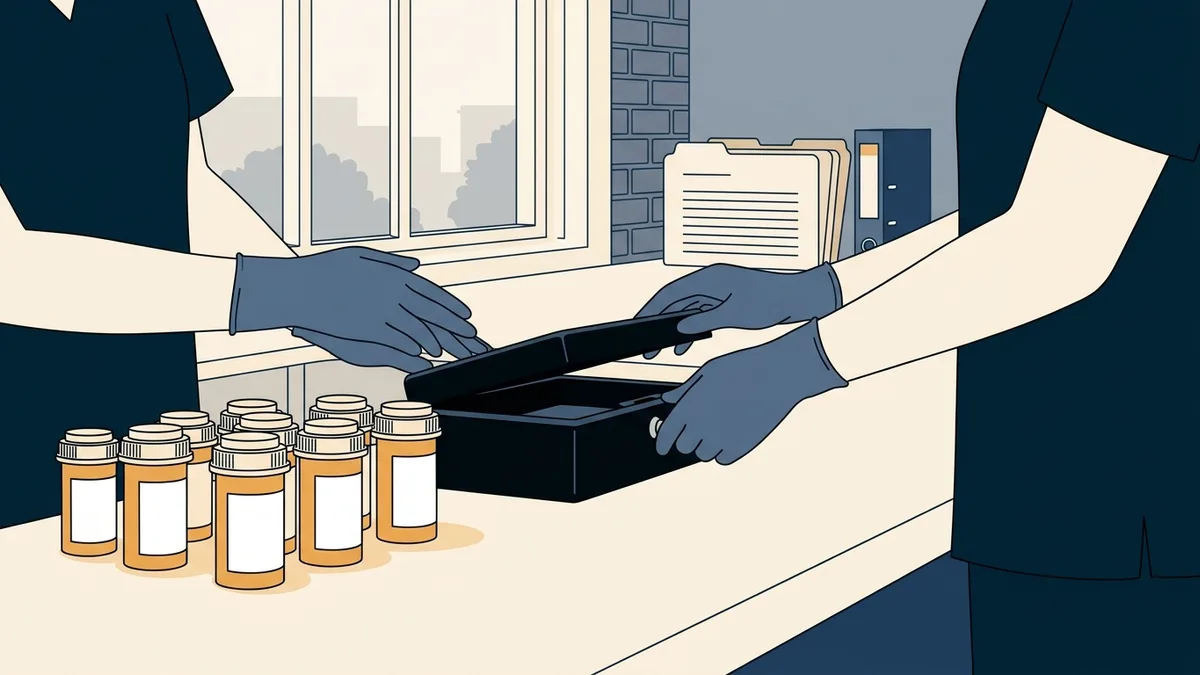
Under 42 CFR 8.12(i), an OTP practitioner may order take-home methadone after weighing six criteria, within limits of 7 days of supply in the first 14 days, 14 days from day 15 and 28 days from day 31, plus closed days. The program documents the rationale, packages and labels doses, educates patients and ties decisions to diversion control.
Take-home doses are where an opioid treatment program's (OTP's) clinical judgment and its compliance obligations meet. The 2024 rule gave practitioners far more room to decide who may take methadone home and for how long. It also tied every decision to written criteria, documentation, packaging rules and the program's diversion control plan. This is about the policy that supports those decisions, not about what any patient should receive: those decisions belong to the medical director and the OTP's practitioners.
What does the rule allow?
Two tiers, in 42 CFR 8.12(i):
- Closed days. "Any patient in comprehensive treatment may receive their individualized take-home doses as ordered for days that the clinic is closed for business, including one weekend day (e.g., Sunday) and State and Federal holidays, no matter their length of time in treatment" (8.12(i)(1)).
- Beyond closed days. Decisions are made "by an appropriately licensed OTP medical practitioner or the medical director," who must consider listed criteria (8.12(i)(2)). If the practitioner determines a patient can safely manage unsupervised doses, methadone supply beyond closed days is limited to 7 days during the first 14 days of treatment, 14 days from day 15, and 28 days from day 31, each "within the OTP practitioner's discretion" (8.12(i)(3)).
Those day limits do not apply to buprenorphine products (8.12(i)(3)). DEA's rules point back to the same standards: every narcotic treatment program "must comply with standards established by the Secretary of Health and Human Services" on quantities provided for unsupervised use (21 CFR 1301.74(k)).
Which criteria must the decision weigh?
The medical director or program practitioner considers, "among other pertinent factors that indicate that the therapeutic benefits of unsupervised doses outweigh the risks" (8.12(i)(2)):
- Absence of active substance use disorders or other physical or behavioral health conditions that raise the risk of harm or affect the ability to function safely.
- Regularity of attendance for supervised medication administration.
- Absence of serious behavioral problems that endanger the patient, the public or others.
- Absence of known recent diversion activity.
- Whether take-home medication can be safely transported and stored.
- Any other criteria the medical director or practitioner considers relevant to the patient's safety and the public's health.
The rule's preamble describes the shift: it removed "from sole consideration the length of time an individual has been in treatment" and "rigid reliance on toxicology testing results" (89 FR 7528).
What must be documented?
The determinations "and the basis for such determinations consistent with the criteria" go in the patient's medical record (8.12(i)(3)), and for each tier the rule repeats that "the rationale underlying the decision to provide unsupervised doses of methadone must be documented in the patient's clinical record." The program also documents the take-home education it gives (8.12(i)(4)). A surveyor reviewing charts on site will look for exactly this: criteria considered, rationale written, education recorded.
Which packaging and education rules apply?
Under 8.12(i)(4), the OTP must maintain procedures to identify theft or diversion of take-home medication, including:
- Labeling containers with the OTP's name, address and telephone number.
- Packaging each take-home dose to reduce the risk of unintended ingestion, including child-proof containers under the Poison Prevention Packaging Act.
- Educating each patient on safely transporting medication home and storing it safely, "including child and household safety precautions," and documenting that education.
A new program's SMA-162 packet already includes "an affirmative statement that the treatment program will use containers for all take-home medication dispensed to outpatients with safety closures," according to SAMHSA's application guidance. The policy should say how that commitment is carried out.
How does the diversion control plan fit in?
Every OTP must keep a current diversion control plan as part of its quality assurance program, with "specific measures to reduce the possibility of diversion of dispensed MOUD" and assigned responsibility for carrying them out (8.12(c)(2)). Take-home procedures are the heart of it. The plan should describe how the program detects concerns (for example, call-backs or medication checks if the program uses them), who reviews them, and how findings feed back into take-home decisions under criterion 4. The rule also requires annual review of program policies and procedures as part of quality assurance (8.12(c)(1)).
Can a state be stricter?
Yes. Part 8 does not limit state authority to regulate MOUD (8.11(e)(1)), and some states set their own take-home rules or require state approval for exceptions. Your take-home policy must satisfy both. Our state pages list the OTP license and authority for each state; read the state's OTP rule for its take-home section and ask the State Opioid Treatment Authority how it applies.
What should the written policy include?
- Who may make take-home decisions, matching 8.12(i)(2) and your state's scope of practice law.
- The six criteria, how each is assessed, and how often decisions are reviewed.
- The day limits by phase of treatment, and the closed-day schedule.
- Documentation requirements, with a chart template that captures criteria and rationale.
- Labeling, packaging and patient education steps, and how education is documented.
- Diversion control measures connected to take-home decisions.
- State-specific limits or approvals.
- How the policy is reviewed each year.
How do we help?
We write take-home, diversion control and related policies as part of our Policy and Procedure Manual add-on ($1,495), cross-walked to 42 CFR 8.12, your accrediting body's elements and your state rule. We never make or review patient-level decisions and never take charts; our deliverables contain no patient information. A Mock Survey ($1,495) checks that documentation practice matches the policy. See the 2024 rule overall and pricing.
Common questions
- How many take-home methadone doses are allowed in the first two weeks?
- Beyond doses for days the clinic is closed, the rule limits take-home supply to 7 days during the first 14 days of treatment, at the practitioner's discretion and based on the listed criteria. Whether any patient receives them is a clinical decision.
- Who decides take-home doses at an OTP?
- An appropriately licensed OTP medical practitioner or the medical director, who must consider the criteria in 42 CFR 8.12(i)(2) and document the basis for the decision in the patient's record.
- Do take-home limits apply to buprenorphine?
- The day limits in 42 CFR 8.12(i)(3) do not apply to buprenorphine products. State rules may still set their own requirements.
Need Help with Enrollment or Licensing?
We prepare your Medicare enrollment, accreditation survey and state licenses in the order CMS requires, for your official to sign, and track every one to a decision.